Social Justice: Introduction
Patient Stories
At only 5.5 pounds (10 pounds less than the fifth percentile for weight on the World Health Organization’s growth chart), an 8-month-old boy suffered from severe malnutrition. In the summer of 2003, amidst the height of Liberia’s civil war, his aunt brought him to the Médecins sans Frontières/Doctors without Borders hospital for treatment. Because of the war, his family had been forced to flee from their home, leaving behind their usual methods of getting food. Dr. Andrew Schechtman was there to help the day the child was brought to the clinic in Liberia (Figure 6-1). Despite the best available treatment for the malnutrition and concurrent pneumonia, the boy died on his third hospital day.
Figure 6-1
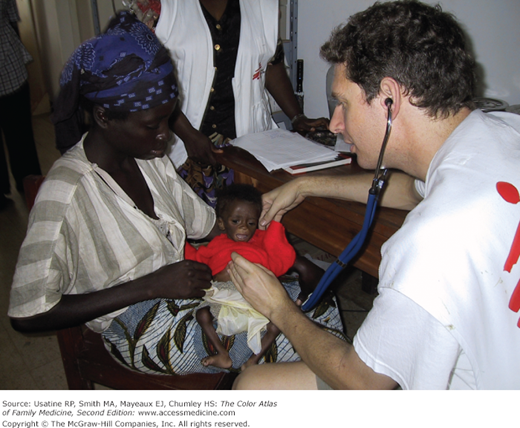
Dr. Andrew Schechtman was there to help the day a severely malnourished child was brought to the clinic in war-torn Liberia. Despite the best available treatment that could be provided in the Doctors Without Borders hospital, the child died of complications of malnutrition and pneumonia—a casualty of war and poverty. (Courtesy of Andrew Schechtman, MD.)
Our Stories as Caring Clinicians
Those of us who become family physicians or other healthcare providers do so for many reasons. One reason is because of a desire to help someone else. Along the way, we sometimes lose ourselves in the day-to-day struggles, the disappointments, the obligations, the fatigue, and the profound helplessness that descends upon us after a particularly bad day. But we are still here and, if we listen with our hearts, we are still capable of great and small things.
We are privileged in so many ways and we must recognize our power over ourselves and over the communities that we serve. It is easy to become overwhelmed by the problems that we face as clinicians and as fellow human beings. Our healthcare system is in shambles, our natural world is being poisoned, our nations are continually at war, and yet, as this chapter highlights, there is so much that we can do—we can listen, we can observe, we can witness, we can bring aid, we can touch, we can love, and we can lead.
Doctors Without Borders (Andrew Schechtman, MD)
The United Nations (UN) High Commissioner for Refugees reported that in 2011 there were 10.9 million refugees (those displaced across an international border) and 27.5 million internally displaced persons (IDPs, those displaced within their own country).1 At the end of 2010, the UN refugee agency was caring for an estimated 14.7 million of these IDPs. During times of a complex humanitarian emergency (defined as a humanitarian crisis in a country, region, or society where there is a breakdown of authority resulting from internal or external conflict and which requires an international response that goes beyond the mandate or capacity of any single agency and/or the ongoing UN country program), the following usually occur:2
- Civilian casualties.
- Populations besieged or displaced.
- Serious political or conflict-related impediments to delivery of assistance.
- Inability of people to pursue normal social, political, or economic activities.
- High security risks for relief workers.
People can be displaced from their homes by manmade (war, persecution) or natural disasters (tsunami, earthquake, or hurricane). War is responsible for most of the displacement. Some of the source countries accounting for the most refugees are Afghanistan, Sudan, Somalia, the Palestinian territories, and Iraq.
- Communicable diseases usually cause the most illness and deaths in humanitarian emergencies in less-developed countries. Children younger than 5 years of age are the most vulnerable.2 Other priority areas include provision of adequate, safe water, food, shelter, and protection from violence.
- In addition to the usual causes of illness and death in emergency-affected populations in less-developed countries (measles, malaria, pneumonia, and diarrhea), crowded settlements may be prone to outbreaks of cholera, meningitis, and other diseases, which can be rapidly spread. Such outbreaks may be explosive and cause many deaths in a relatively short period of time.
In times of stability, writes Dr. Andrew Schechtman, many of the poorest people in the world succeed in their struggle to meet basic needs for shelter, food, and water. When displaced from their homes by manmade or natural disaster, communities and extended families are disrupted, access to food and water are lost, and marginal circumstances become desperate. Displaced people are often dependent on the support of the international aid community to meet their basic needs.
When infrastructure collapses as a result of manmade or natural disasters, access to healthcare can be limited or nonexistent. Serving as a volunteer physician with Medecins sans Frontieres (Doctors Without Borders) allowed Dr. Schechtman to provide medical care to people in desperate circumstances who had nowhere else to turn for assistance. Bearing witness to tragedies such as the case described in Figure 6-1 gave him another means to help, that is, the authority to speak out on behalf of victims like this child, focus public attention on the situation, and encourage political pressure to bring the fighting to an end.
Access and Advocacy: Prosthetic Parity (Jeff Cain, MD)
Health insurance reform is on the minds of many, as the US citizens debate the pros and cons of President Obama’s healthcare bill. In the midst of this debate, many people find themselves without health insurance. The 2010 U.S. Census Bureau reported that the percentage of people without health insurance (16.3%) although not statistically different from the rate in 2009, resulted in an increase in the number of uninsured people from 49.0 million to 49.9 million; this percentage of uninsured is 4% higher (representing 5.1 million more people) than at the first writing of this book in 2005.3
- Lack of insurance disproportionately affects Hispanics (30.7% are uninsured), followed by blacks (20.8%), Asians (18.1%), and non-Hispanic whites (11.7%).4 (Figures 6-2 and 6-3)
- According to the American College of Physicians 2000 report, uninsured Americans may be up to three times as likely as privately insured individuals to experience adverse health outcomes and up to four times as likely as insured patients to require both avoidable hospitalizations and emergency hospital care.5
- Uninsured adults have a 25% greater mortality risk than adults with coverage; approximately 18,000 excess deaths among people younger than age 65 years are attributed to lack of coverage every year.6
- In 2007, 62% of personal bankruptcies were caused by medical bills, a rise of almost 50% since 2001.7 Importantly, of those bankruptcies, three quarters were actually insured at the time of their illness.
Figure 6-2
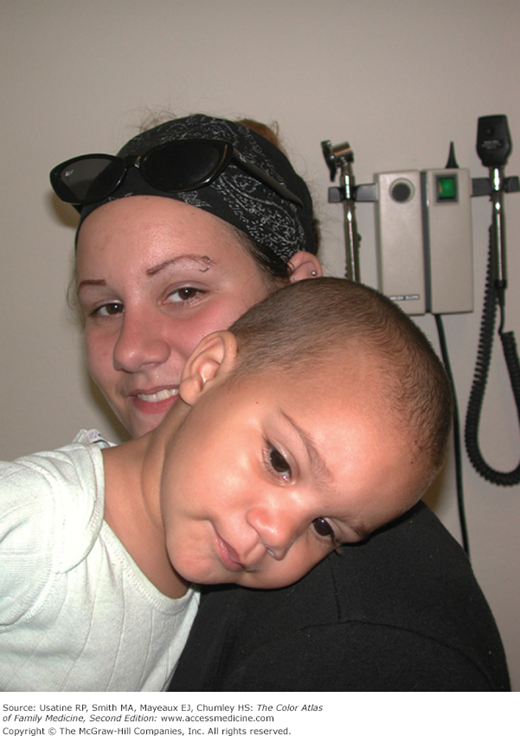
This mother and child are being cared for in the University of California at Los Angeles (UCLA)/Salvation Army free clinic run by medical students for homeless families in a transitional housing village. The boy had a bacterial infection on his leg and required antibiotics. The computer system in a pharmacy rejected his name and number, but, fortunately, the family doctor advocated for this child and the medicine was obtained. (Courtesy of Richard P. Usatine, MD.)
Figure 6-3
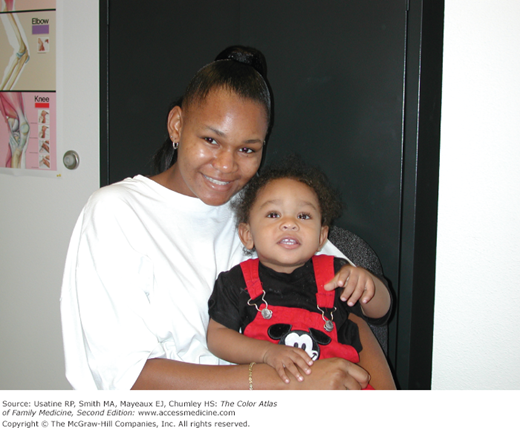
This 18-year-old mother has had type I diabetes since age 13 years. As a single mom she qualified for one of the living units within the Salvation Army transitional housing village. The week before this photo was taken, she presented to the student-run free clinic with diabetic ketoacidosis secondary to running out of her insulin. She knew that she needed her insulin but the pharmacy would not fill it because her insurance appeared to have lapsed in the computer system. After many calls to many pharmacies with no luck, her needed insulin was obtained from another free clinic in town. She survived without hospitalization and was feeling much better at the time of this photograph. (Courtesy of Richard P. Usatine, MD.)
One area where insurance coverage may be limited is for prosthetics, where coverage may consist of a single lifetime prosthesis or be placed under restrictive arbitrary caps that cover less than a third of the cost. Unfortunately, limb loss is fairly common and risk is greatest among vulnerable populations:
- In 2005, 1.6 million people (approximately 1 in 190) in the United States were living with limb loss.8
- In 1997, 131,218 hospital discharges had a lower extremity amputation (LEA) discharge diagnosis code.9 Regardless of comorbidity, these rates were higher for men than women and higher for non-Hispanic blacks than for Hispanics or non-Hispanic whites.9 According to the Disparities in Health and Health Care among Medicare Beneficiaries, the rate of amputation is four times greater in blacks than in whites.10
- Most cases of limb loss are as a consequence of vascular disease (54%), trauma (45%), and cancer (<2%).7
- Of the 1997 hospital discharges noted above, 67% were related to diabetes.9 The age-adjusted LEA rate for persons with diabetes (5.5 per 1000 persons) was 28 times that of persons without diabetes (0.2 per 1000 persons).
- Nearly half of the individuals who have an amputation as a consequence of vascular disease will die within 5 years.11 This is higher than the 5-year mortality rates for breast cancer, colon cancer, and prostate cancer.
- Of persons with diabetes who have a LEA, up to 55% will require amputation of the second leg within 2 to 3 years.12
As a practicing family physician in Denver, Colorado, Jeff Cain had already been a leader for health advocacy in cocreating a tobacco-free education program for children called Tar-Wars. This program has grown from a local Denver activity into an international campaign reaching more than 8.5 million children in all 50 states and in 14 countries.
Dr. Cain became acutely aware of insurance disparity for patients with disabilities when a 1996 airplane accident resulted in a LEA and he was surprised to find his hospital residency’s insurance policy provided only $1000 for a year’s prosthetic benefits, far short of the needed cost. Although he was fortunate to be able to afford the much larger copay for his prosthetics himself, most Americans could not. Indeed, he found that most insurance companies did not provide enough coverage for most amputees to afford the necessary prosthetics to fully live their lives.
To change the situation, Dr. Cain (Figure 6-4) founded and led the Colorado Coalition of Working Amputees, a grassroots organization whose work led to Colorado becoming the first state to pass “prosthetic parity” insurance legislation in 2001. This legislation required insurance companies to pay for artificial arms and legs.
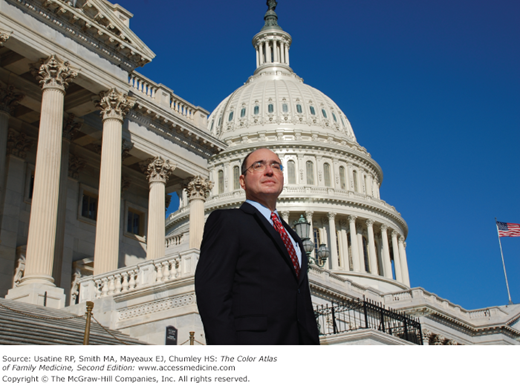
Following this success, Dr. Cain joined the board of directors of the Amputee Coalition of America where he provided vision and leadership establishing the Coalition’s Action Plan for People with Limb Loss. The Amputee Coalition created a tool kit modeled on materials developed by the Colorado Coalition of Working Amputees, which has been used by grassroots organizations across the country to advocate for changes in insurance laws on the state level. This work has led to 20 states passing insurance mandate legislation with 16 introducing legislation and 8 states organizing for introduction of legislation in 2012. Dr. Cain participated in Hill Visit days in 2010 and 2011, resulting in the introduction of the 2012 federal Fair Insurance Access for Amputee bill, and was instrumental in President Obama’s signing of a proclamation for April 2012 as Limb Loss Awareness Month.
Dr. Cain encourages others to advocate for justice using personal stories that help us connect with each other and with the larger community. He states, “A story has superpowers for persuading people of the importance of your cause. If you can combine your story with the facts and economic reality, people will line up with your position.”
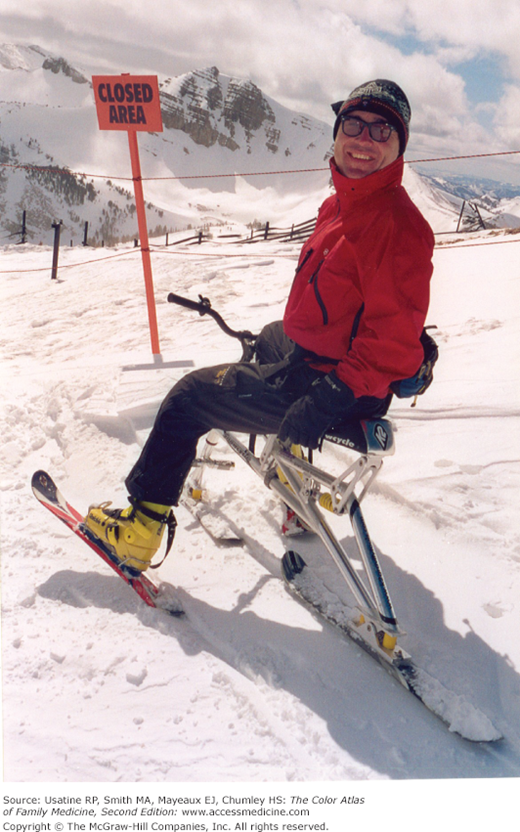
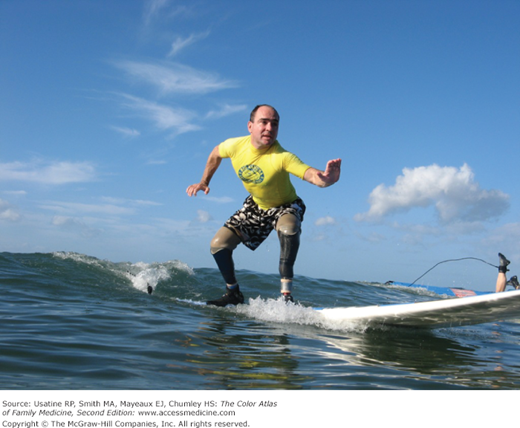
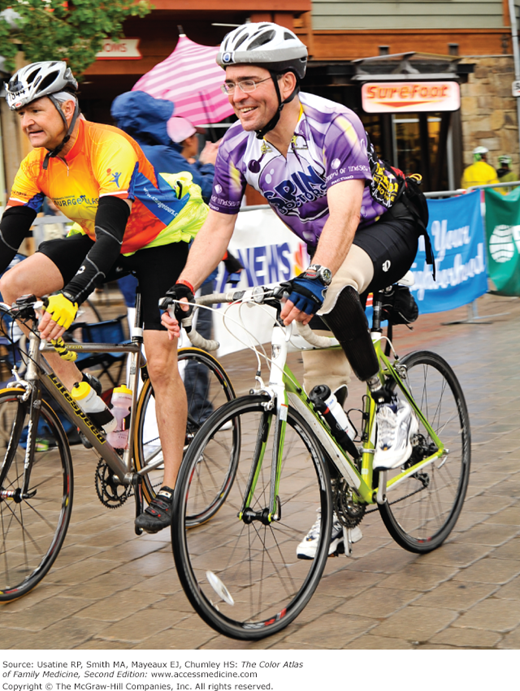
As current president of the American Academy of Family Physicians, Dr. Cain continues his leadership and advocacy work. In addition, as a sports enthusiast and gold medal winner in adaptive slalom snowboarding (Figure 6-5), Dr. Cain works to develop and share ways to adapt sports equipment for use by people with limb loss (Figures 6-6 and 6-7), improving quality of life and health through exercise.
Refugees and Asylum Seekers (Lucy Candib, MD)
A refugee is a person who is outside his or her country of nationality or habitual residence; has a well-founded fear of persecution because of his or her race, religion, nationality, membership in a particular social group, or political opinion; and is unable or unwilling to avail himself or herself of the protection of that country, or to return there, for fear of persecution. Worldwide, in 2010, there were approximately 15.6 million refugees and approximately 27.5 million persons displaced within their own countries.13
An asylum seeker is an individual who has sought international protection and whose claim for refugee status has not been determined yet. As part of its obligation to protect refugees within its territory, the country of asylum is normally responsible for determining whether an asylum seeker is a refugee or not. As of January 2011, there were 264,574 officially settled refugees residing in the United States and 6285 asylum seekers.14

Stay updated, free articles. Join our Telegram channel

Full access? Get Clinical Tree


