Patient Stories
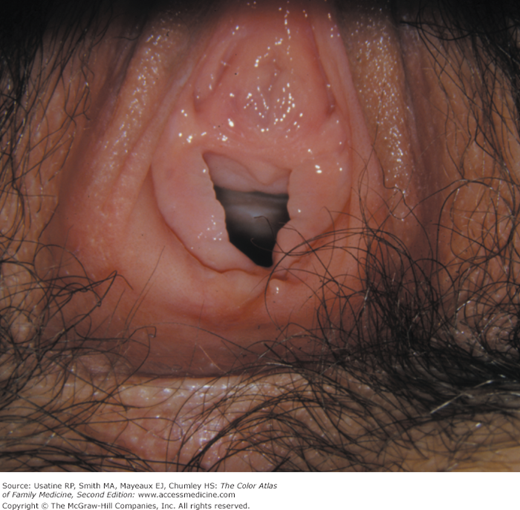
A 19-year-old college girl presents to the office after being raped 3 weeks ago. She went out on a date and was forced to have sex against her will. She states that she had been a virgin and that he made her bleed by penetrating her vagina with his penis. She tried to stop him, but was afraid to fight too hard because he was a strong man and was drunk. She is in tears as she tells her story. She waited so long to come in for help because she did not know where to turn. She took emergency contraception (EC) immediately, and a home pregnancy test taken last night was negative. She wants to be checked for any sexually transmitted infections (STIs). Upon examination, there is a tear of her hymen at the 5-o’clock position that has healed (Figure 11-1). There are no signs of infection and STI screening is performed. She is afraid to prosecute but would like to be referred to a rape-counseling program.
A 47-year-old woman is seen in follow-up for depression. She admits to being raped in a parking lot several months prior but did not report it to the police. She is continuing to have intrusive nightmares and flashbacks of the event. She is having difficulty concentrating at work and does not feel comfortable in social situations.
Introduction
Sexual violence is a sex act completed or attempted against a victim’s will or when a victim is unable to consent because of age, illness, disability, or the influence of alcohol or other drugs.1 It may involve actual or threatened physical force, use of guns or other weapons, coercion, intimidation, or pressure. Sexual violence includes unwanted intercourse (completed sex act defined as contact between the penis and the vulva or penis and anus involving penetration); an attempted sex act, abusive sexual contact (intentional touching either directly or through clothing of the genitals, anus, groin, breast, inner thigh, or buttocks against a victim’s will or when a victim is unable to consent); and noncontact sexual abuse, such as voyeurism, intentional exposure to exhibitionism, undesired exposure to pornography, verbal or behavioral sexual harassment, threats of sexual violence, or taking nude photographs of a sexual nature of another person without his or her consent or knowledge or of a person unable to consent or refuse.
Epidemiology
- Based on the National Intimate Partner and Sexual Violence Survey (NISVS; 2010) of more than 16,000 adults, nearly 1 in 5 women (18.3%) and 1 in 71 men (1.4%) in the United States has been raped.2 More than half of the women were raped by an intimate partner (see Chapter 10, Intimate Partner Violence) and 40.8% were raped by an acquaintance. Among men, more than half were raped by an acquaintance and 15.1% by a stranger.2
- Unwanted sexual contact was reported in the NISVS by 27.2% of women and 11.7% of men.2
- Lifetime stalking victimization was reported by 1 in 6 women (16.2%) and 1 in 19 men (5.2%) in the NISVS.2
- Most victims of sexual assault are young:
- In the NISVS, most women (79.6%) experienced their first completed rape before age 25 years and 42.2% before the age of 18 years.2 More than one-quarter of male victims of completed rape (27.8%) experienced their first rape before they were 11 years of age.
- Similar findings were reported in another national survey where 60.4% of female and 69.2% of male victims were first raped before age 18 years.3 A quarter of females were first raped before age 12 years.
- In the NISVS, most women (79.6%) experienced their first completed rape before age 25 years and 42.2% before the age of 18 years.2 More than one-quarter of male victims of completed rape (27.8%) experienced their first rape before they were 11 years of age.
- In surveys of college students, annually 10% of women described a rape, 17% reported an attempted rape, 26% reported unwanted sexual coercion, and 63% experienced unwanted sexual contact.4
- Women in substance abuse treatment are a particularly high-risk group for having experienced violence. In one study, 89% reported a history of interpersonal violence and 70% reported a history of sexual assault.5
- Men are most often the perpetrators of sexual violence;2 even among male victims, predominantly male perpetrators committed the rape or noncontact unwanted sexual experiences reported, and almost half of stalking victimizations of men were perpetrated by men.
- According to the FBI Uniform Crime Reports, there were an estimated 84,767 forcible rapes reported to law enforcement in 2010 or 54.2 per 100,000 women, a decrease of 5% from 2009 and 6.7% lower than 2001.6 Most women, however, do not report being raped to the police:
- As in the cases presented in this chapter, most cases of sexual assault go unreported (only about 1 in 5 women report their rape to police).7 Reasons for failing to report include fear of reprisal, shame, fear of the justice system, and failure to define the act as rape. Furthermore, according to victim accounts in the NISVS, only 37% of the rapes reported to police resulted in the rapist being criminally prosecuted, and of those prosecuted, less than half (46.2%) were convicted of a crime.2
Etiology and Pathophysiology
- Two types of factors are believed to contribute to sexual violence—Vulnerability factors that increase the likelihood that a person will suffer harm and risk factors that increase the likelihood that a person will cause harm. Neither vulnerability nor risk factors are direct causes of sexual violence.3
Risk Factors
- Prior history of sexual violence.
- Being disabled (physical, psychiatric illness, or cognitive impairment).
- Pregnancy.
- Poverty, homelessness.
- Having many sexual partners or involved in sex work.
- Consuming alcohol or illicit drugs.
- Alcohol and drug use.
- Childhood history of physical or sexual abuse and/or witnessed family violence as a child.
- Coercive sexual fantasies.
- Preference for impersonal sex.
- Hostility toward women.
- Association with sexually aggressive and delinquent peers.
- Family environment characterized by physical violence and few resources.
- Poverty and lack of employment opportunities.
- Societal norms that support sexual violence, male superiority, and sexual entitlement.
- Weak laws and policies related to gender equity.
Diagnosis
It is recommended that patients are asked directly about violence during routine visits, when seen in the emergency department, or when presenting with substance abuse, depression, and/or physical clues (as listed below) so as to identify those who are suffering from the aftermath of sexual or physical violence.
- Approximately 33% of women and 16% of men have physical injuries as a result of a rape; 36.2% of injured women received medical treatment.1
- Women who are raped are significantly more likely than nonraped women to experience genital injuries and STIs, and have significantly greater difficulties with aspects of reproductive/sexual functioning, including dyspareunia, endometriosis, menstrual irregularities, and chronic pelvic pain.11
- Many women suffer psychological trauma following sexual assault such as posttraumatic stress disorder (PTSD) symptoms:1
- Immediate psychological consequences include confusion, anxiety, withdrawal, fear, guilt, intrusive recollections, emotional detachment, and flashbacks.
- Some victims may attempt suicide after being raped (Figure 11-2).
- Immediate psychological consequences include confusion, anxiety, withdrawal, fear, guilt, intrusive recollections, emotional detachment, and flashbacks.
Figure 11-2
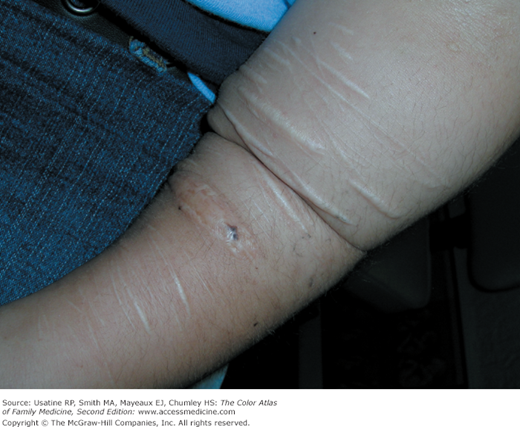
The mutilated arm of a 26-year-old woman who was raped 5 years prior to this photograph. After being raped, she became suicidal and began cutting her arm repeatedly. The additional malformation of the arm is secondary to osteomyelitis from previous intravenous drug use. (Courtesy of Richard P. Usatine, MD.)




